

There’s a function that seems to know where the prime numbers live. The Riemann hypothesis is a claim about that function, it has been open since 1859, and the Clay Mathematics Institute will pay a million dollars to whoever settles it.
Here’s the function:
ζ(s) = 1⁻ˢ + 2⁻ˢ + 3⁻ˢ + 4⁻ˢ + …
Feed it a complex number s and, with a suitable extension of the definition, you get a value back. Some inputs return exactly zero. A batch of those are boring and fully understood: the negative even integers, called the trivial zeros. The interesting ones, the non-trivial zeros, all seem to line up on a single vertical line in the complex plane, the line where the real part of s equals 1/2.
The Riemann hypothesis says: every last one of them is on that line. No stragglers, ever.
Why anyone should care where zeros sit
Because of what Riemann showed on the way to the conjecture. The zeros of this function control the distribution of the primes. How can a smooth function know about the primes, which look like pure static? Because there’s an exact formula rebuilding the prime counts from the zeros: each zero contributes a wave, and the primes emerge from the interference pattern. If all the zeros sit on the critical line, the primes are as evenly spread as they can possibly be, and a whole family of error terms across number theory snaps to its best possible bound. If even one zero sits off the line, the primes have a bias nobody has detected, and hundreds of theorems that begin “assuming the Riemann hypothesis” lose their footing.
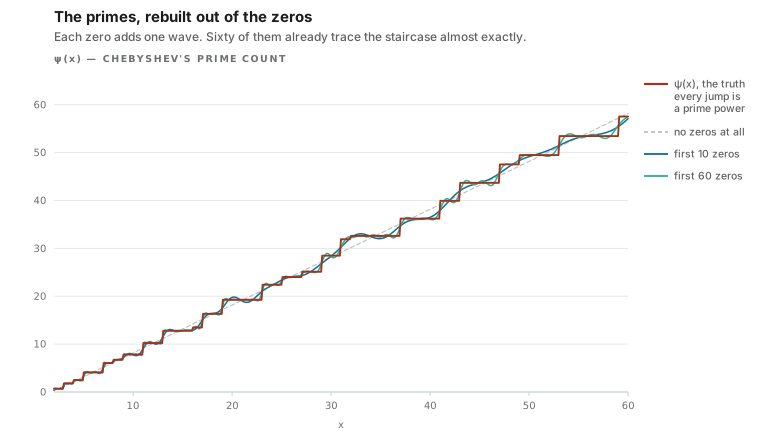
I generated that with the first sixty zeros and a sieve, because the claim is much more convincing when you watch it happen. The smooth ramp is what you get knowing nothing about the zeros. Every wave you add is one zero speaking, and they interfere their way into the exact positions of the primes.
That’s the real stake. It isn’t one isolated puzzle; it’s a load-bearing wall. Results about prime gaps, about how well we can approximate the prime-counting function, even estimates that matter for cryptography, lean on it.
The evidence, honestly stated
Computation is lopsidedly in favour. Not the first million zeros. The first ten trillion have been computed, and every one lies exactly on the critical line. There are also structural results: Hardy proved in 1914 that infinitely many zeros lie on the line, and later work showed a positive fraction of them must.
And yet, as with Goldbach, none of that is a proof. Number theory has a humbling history on this point. Some plausible conjectures with mountains of numerical support have turned out false, with the first counterexample living at a height no computation would ever visit. Ten trillion polite zeros constrain nothing about the ten-trillion-and-first.
Can you touch it yourself?
You can. The zeros are computable, and libraries in Python (mpmath) and R will hand you as many as you like; the first one sits at about 1/2 + 14.13i. There’s something clarifying about printing a few and watching the real parts come back 0.5, 0.5, 0.5. It converts the problem from folklore into an object.
What it doesn’t convert into is a proof, and that’s the lesson I take from this one every time I revisit it. The gap between “true in every case we can reach” and “true” is where the whole difficulty lives. In mathematics, and honestly, in a lot of the inference work we do for a living too.