

Pick an even number bigger than 2. Any one. Now try to write it as the sum of two primes.
4 = 2 + 2. 6 = 3 + 3. 8 = 3 + 5. 100 = 3 + 97. It works every single time, as far as anyone has ever checked, and nobody on Earth can prove it always will. That’s the Goldbach conjecture, and it has been sitting there unsolved since 1742, when Christian Goldbach floated it in a letter to Leonhard Euler.
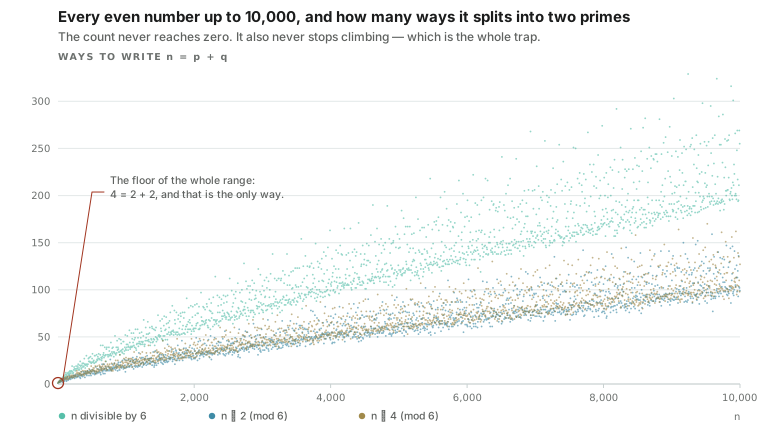
That shape is the trap, drawn. Not only does the count never hit zero, it climbs — so the bigger the number, the more ways there are for it to work, and the safer the conjecture looks. Feeling safe and being proved are different things, and the picture cannot tell you which one you are looking at.
I love this problem for the same reason I love the Collatz conjecture: you can explain it to a ten-year-old in one minute, and then you can spend a career failing to prove it. That gap between how easy a thing is to state and how hard it is to settle tells you something true about mathematics.
How far has checking got us?
Computers have verified the conjecture for every even number up to about 4 × 10¹⁸. Four quintillion. The big systematic push was Tomás Oliveira e Silva’s distributed computation, which ground through that entire range and found no exception.
So is it true? Almost certainly. Is it proven? Not even close, and here’s the thing people outside mathematics find strange: those two statements can both hold at once. Checking four quintillion cases proves exactly four quintillion cases. The conjecture makes a claim about all even numbers, and there are infinitely many left after any check you can run. One counterexample hiding at 10¹⁰⁰ would sink the whole thing, and no computer will ever reach it by brute force.
Why is it so hard?
Two reasons, and they compound each other.
Primes are multiplicative objects. They’re defined by what divides them. But Goldbach is a claim about addition — about which numbers you can build by summing primes. Mathematics has spectacular machinery for the multiplicative side and much weaker machinery for questions that mix the two. The primes are individually easy to find and collectively very strange, and their gaps and clusters don’t follow a formula anyone has tamed.
The second reason is the infinity problem I mentioned. A proof has to work for every even number at once, which means finding structure, some reason the sums must always land, rather than confirming instances. Nobody has found that reason in 280 years.
Progress has come at the edges, and some of it is genuinely beautiful. Analytic number theory, the toolkit descending from Riemann’s zeta function, gave us results like Vinogradov’s theorem, which proves that every sufficiently large odd number is the sum of three primes. Harald Helfgott completed that “weak Goldbach” result for all odd numbers above 5 in 2013. The strong version, two primes for every even number, still stands open.
Why I keep coming back to it
Because it’s a working lesson in what evidence is and isn’t. Four quintillion confirmations feel like certainty, and in any applied setting we’d have shipped long ago. Mathematics refuses to, and that refusal is the discipline’s whole character. In our modelling work I think about this more than you’d expect: a pattern that has held every time you’ve looked is not the same thing as a pattern that must hold, and the day someone bets real money on the difference is the day it matters.
Try a few even numbers yourself. It never fails. Nobody knows why.