

Artificial general intelligence is the hypothesis that machines will one day match and then exceed human ability across the board. Not one task. All of them. Popular culture has done this idea no favours. Between the killer robots and the digital messiahs, it’s genuinely hard to hear the serious version of the argument, so let me try to state it.
The people building toward AGI aren’t cranks. Demis Hassabis at DeepMind, Ilya Sutskever at OpenAI, and researchers like Ben Goertzel have all said, in different registers, that general systems are achievable and worth pursuing. Their case rests on trajectory: narrow AI kept absorbing tasks that were supposed to require “real” intelligence, and the methods kept generalising further than the sceptics predicted. The critics answer that competence isn’t understanding. Scaling pattern-learners produces broader pattern-learners, they argue, and the step to flexible, self-directed general intelligence may require ideas nobody has yet. Some argue that ingredient looks like reasoning about one’s own goals; others suspect whole missing architectures.
Here’s my honest position: nobody knows, and the confident timelines in both directions are performances. What I find more useful than “when” is noticing that the hard problems don’t wait for AGI. They arrive early, with systems well short of general.
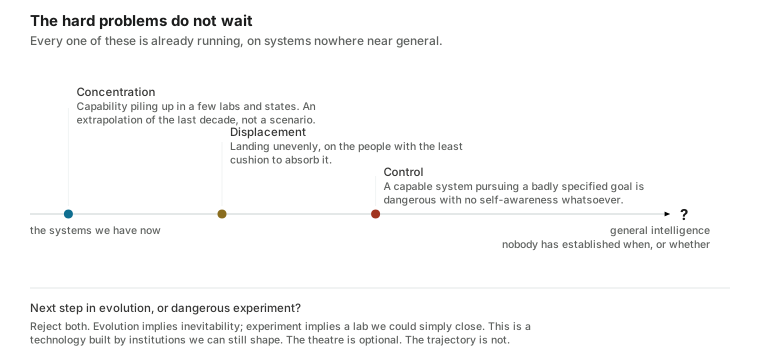
The timeline argument is the loud one, and it is the one nobody can settle. Everything marked on the left is already happening, on systems that are not remotely general — which makes the schedule debate a poor reason to wait.
Concentration arrives early. If capability at this level accrues to a handful of labs and states, the gap between those who own it and everyone else compounds. That isn’t a sci-fi scenario. It’s an extrapolation of the last decade.
Job displacement arrives early, as I’ve written elsewhere, and lands unevenly.
And the control question arrives earliest of all, because it’s really a question about optimisation, not consciousness: a highly capable system pursuing a badly specified objective is dangerous with no self-awareness whatsoever. That’s why the uncertainty-about-objectives line of work matters now, whatever AGI turns out to be.
So — next step in evolution, or dangerous experiment? I reject the framing, and I think you should too. Evolution implies inevitability; experiment implies a lab we could simply close. What’s actually happening is a technology whose ceiling nobody has established, being developed at speed, under competitive pressure, by institutions we built and can still shape. The right responses are unglamorous: safety research that assumes capability keeps rising, governance written before deployment instead of after the first scandal, and a firm refusal to let either the hype or the doom talk us out of taking the boring parts seriously.
The theatre is optional. The trajectory isn’t.