

Every wave of automation triggers the same two headlines: the machines will take every job, and the machines will free us all. Both have been wrong every previous time, and the honest position on AI is that it will be wrong this time too — while something real happens in between.
The real thing is displacement, and it’s worth being precise about who it lands on. AI doesn’t automate jobs so much as tasks, and it takes the routine ones first. The result isn’t mass unemployment overnight. It’s pressure, concentrated on people whose work is mostly routine tasks, who are disproportionately the people with the least cushion to absorb a career change. Meanwhile, new work genuinely does appear. Someone has to build, maintain, audit and improve these systems, and whole occupations exist today that didn’t when I started. The uncomfortable truth is that the people gaining the new work and the people losing the old work are mostly not the same people. That’s the inequality mechanism, and it’s more concerning than any robot-uprising scenario because it’s already running.
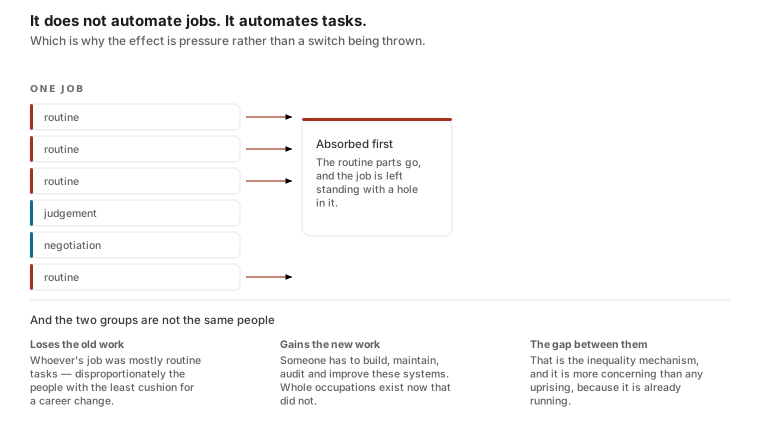
Drawn out, the thing to look at is the bottom row rather than the top. Task-level automation is the well-understood part. What decides how this actually goes is that the two groups of people are different groups.
The effects that worry me most aren’t even economic. AI systems were already, in 2022, scoring risk in criminal justice and screening candidates for jobs — decisions with real consequences, made partly by models trained on data that encodes every past bias we ever practised. A hiring model trained on yesterday’s hires reproduces yesterday’s prejudices with a straight face and an objective-sounding score. Nobody has to intend that outcome. It’s the default.
So what does preparing actually look like? Three things, none of them exotic.
Education and retraining, funded like we mean it, aimed at the people the pressure lands on rather than the people writing think-pieces about it. The skills that hold value are the ones models complement instead of replace: judgement, cross-domain reasoning, and the ability to work with these systems.
Second, a policy conversation about distribution that starts before the concentration is finished, because the gains from automation flow to whoever owns the automation, and that isn’t a law of physics — it’s a choice of rules.
And third, real accountability for consequential decisions. Not a voluntary ethics charter. Standards with teeth for any system that decides who gets bail, a loan, or an interview, including the right to know why.
None of this is anti-AI. I build these systems for a living and I think the ceiling on what they can do for us is very high. But “what should we expect?” has a grown-up answer, and it isn’t utopia or apocalypse. It’s a powerful general technology arriving into our existing institutions, amplifying whatever we’ve already built. Including the parts we should have fixed first.