

People use “AI” and “machine learning” as if they’re the same word. I understand why; the marketing departments of the world have worked hard to blur them. They aren’t the same. The difference takes two minutes, and it’s worth every one of them.
Here it is. AI is the ambition; ML is a method. Artificial intelligence is the broad goal of machines doing things that would need intelligence from us: reasoning, planning, understanding language, making decisions. Machine learning is one specific way of getting there — you don’t program the behaviour in, you let the system learn it from data.
That means every ML system is doing AI, but not everything under the AI umbrella is ML. Consider a chess program built entirely on hand-written search and evaluation rules, the kind people were writing decades before anyone said “deep learning”. It decides. It plans. Nobody taught it from examples, though. Someone coded the judgement in directly, which makes it AI with no learning in it anywhere.
The cleanest way I know to feel the difference is a pair of examples.
AI without ML: that classic chess engine. It analyses the position, considers moves, picks the best one. All of that logic came from a programmer’s head.
ML doing AI: a program that recognises cats in photos. Nobody wrote down what a cat looks like. Nobody could. The system saw a hundred thousand labelled images and worked out the pattern itself, which is supervised learning, the workhorse of the field.
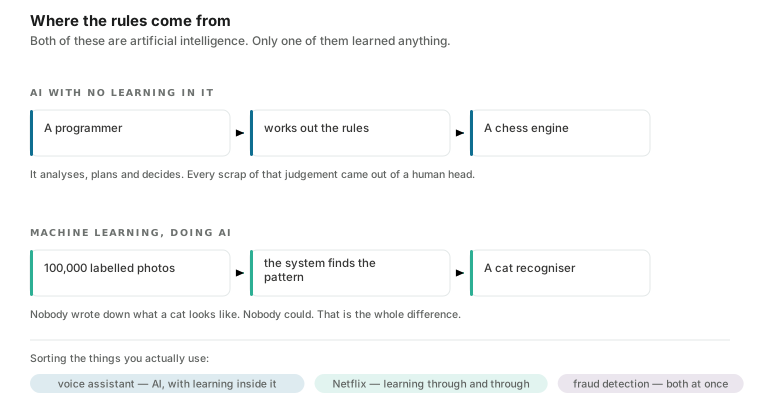
Both rows are artificial intelligence. The only thing that changes between them is where the rules came from.
Once you have the lens, you can sort the products you use every day.
Your voice assistant is AI in the broad sense: it parses language, decides what you meant, acts. Learning shows up inside it in specific places, like adapting to your accent. A self-driving car is the same shape: a big AI system, with learned components doing the seeing.
Netflix recommendations are ML through and through: learn from what millions of people watched, predict what you will. Spam filtering? Same story. A model trained on mail people flagged. A trading algorithm learning from its own outcomes is the third flavour, reinforcement learning, where the feedback is consequences rather than labels.
And fraud detection is where the two visibly work together: hand-written rules catch the known patterns, while learned models hunt the anomalies nobody has written a rule for yet.
Does the distinction matter outside of pedantry? In our work, constantly. When a client asks for “AI”, the first real question is whether the problem needs learning at all. Sometimes a dozen honest rules beat a model, cost nothing to explain, and never drift. Sometimes only a model will do, because nobody can write the pattern down. Knowing which situation you’re in is most of the job. It starts with keeping these two words apart.