

There’s a joke physicists have told for generations: fusion is ten years away, and always will be. I heard it over lunch at the Institute for Defense Analyses back in 2012, delivered with the weary timing of someone who’d heard it in graduate school themselves. On 13 December 2022, the week I’m writing this, the joke finally took some damage.
The Department of Energy announced that the National Ignition Facility at Lawrence Livermore had achieved ignition: a controlled fusion reaction releasing more energy than the laser energy delivered to the target. Decades of near-misses. Then one actual net-positive shot.
Why does this matter so much? Because fusion is the energy source underneath everything. It’s what powers stars. Light nuclei forced together. Mass converted to energy. No carbon, no long-lived waste, fuel effectively everywhere. And because energy scarcity sits under a depressing share of modern conflict, a working fusion economy would remove one of the oldest reasons nations fight.
The uncomfortable footnote is that humanity has produced fusion at scale since 1952, in thermonuclear weapons, starting with the first detonation on 1 November of that year. Uncontrolled fusion, we mastered quickly. It’s the controlled version, holding a plasma at stellar temperatures steadily enough to farm energy from it, that has consumed seventy years. The whole difficulty of the field lives in that one word.
Control problems, though, are exactly where machine learning has begun to earn a place. A plasma is a writhing, unstable thing. Hundreds of sensors watch it. Magnetic fields steer it on millisecond timescales, far too fast and too high-dimensional for a human in the loop. At the Joint European Torus, ML models have been used to optimise plasma confinement, learning from experimental shots which control settings hold the plasma stable. ITER, the 35-nation reactor under construction in France, is planning on the same family of tools at greater scale.
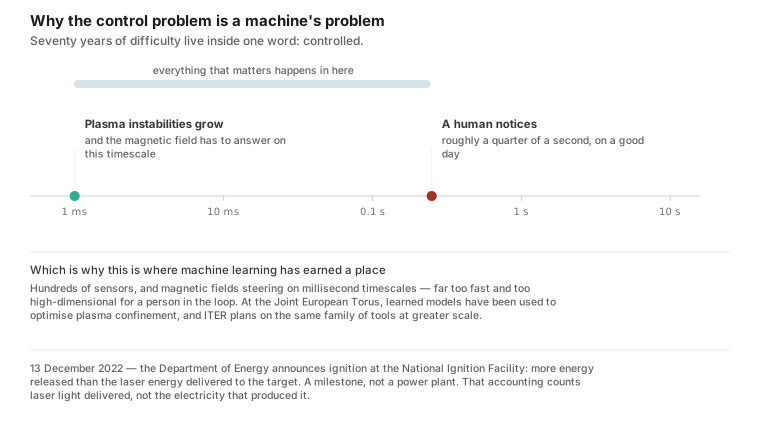
Put the two timescales on one axis and the argument makes itself. There is no version of this where a person sits in the loop. The only question is what does.
Looking forward from this week’s news, the openings for AI in fusion are easy to name. Simulation surrogates: full plasma-physics simulations are brutally expensive, and learned models that approximate them well would let researchers explore designs orders of magnitude faster. Real-time control and optimisation: steering temperature, pressure and confinement continuously, and reacting to instabilities before they grow. And safety: anomaly detection over the sensor streams, flagging conditions no operator would catch in time.
I’d add the honest caveat that ignition at NIF is a milestone, not a power plant. The energy accounting counts laser light delivered, not the electricity that produced it, and the road from one igniting pellet to a grid-connected reactor is long. But for the first time in my scientific life, the ten-years joke has a real experimental result standing against it. Physics moved. It never does that on schedule, which is exactly what makes it worth writing down when it does.