

In late 2022 the question was suddenly everywhere: is this the end of Google? ChatGPT had just landed, it answered questions in full sentences, and typing keywords into a search box abruptly felt like using a rotary phone.
My answer at the time was no. And since predictions in this field usually deserve a scorecard, I’m leaving this one up to be checked.
The case for language models in search was obvious even then. A model that understands language as probability distributions can do things keyword matching never could. Ask “what are the top attractions in Rome, and how do I reach each one from the city centre?” and a keyword engine sees a bag of words; a language model sees a two-part question with an itinerary hiding in it. Ambiguity is the other win. “A good coffee shop in the city” means your city, open now: context a model can hold and a keyword index can’t. And the answer can come back as a sentence rather than ten blue links.
So why not replacement? Because search engines do a job that generating text doesn’t touch: they index the live web, they point at sources, and they’re accountable to them. A search result says here’s where this came from; a generated answer says trust me. A model’s knowledge also freezes at training time, while the web changes hourly. And fluent doesn’t mean correct. A language model will state a wrong answer with exactly the confidence of a right one, which is fatal in a tool whose one job is finding the truth.
What I expected instead was a merger: models as the understanding-and-presentation layer wrapped around retrieval, with the index still underneath doing the honest work of knowing where facts live.
Reading it back, that’s roughly what happened. The assistants learned to search and cite; the search engines grew generated summaries with links hanging off them. The architecture even got a name, retrieval-augmented generation, and it’s precisely the marriage described above: fetch real documents first, then let the model answer from them, on the record.
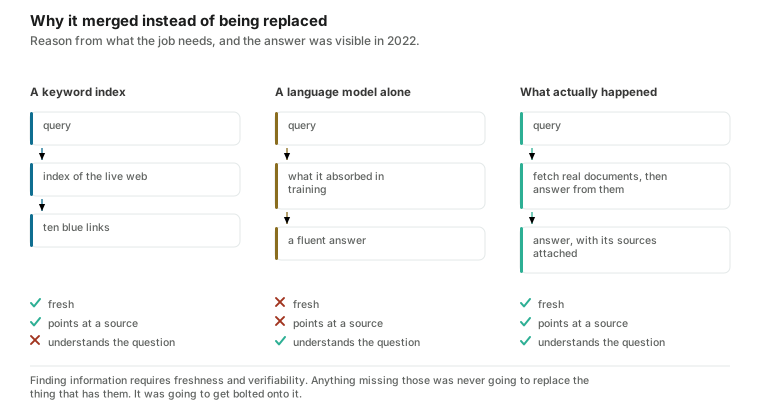
Laid out as a scorecard, the prediction stops looking clever. Two of those columns each fail a property the job cannot do without, and there was only ever one way to get all three.
The lesson I keep from this post isn’t that the prediction aged well. It’s why it did. The reasoning wasn’t about which company would win; it was about which properties the job requires. Finding information requires freshness and verifiability. Any technology missing those wasn’t going to replace the one that has them. It was going to get bolted onto it. Reason from what the job needs and your predictions survive contact with the future far more often than reasoning from the demo.