

Healthcare generates more data per patient than almost any human activity — scans, labs, notes, monitors, histories. For decades most of it was written once and read never. That’s the real story of AI in medicine. Not robot doctors. Just finally reading what we already record. It’s also work we do, so this is a field report as much as a survey.
Where do models actually earn their keep today? Four places, in descending order of maturity.
Imaging is the most proven. Radiology is pattern recognition under time pressure, and that’s the one thing deep learning does at superhuman consistency. Models now flag tumours, fractures and retinal disease at accuracy rivalling specialists, in narrow, well-defined tasks. The operative word is flag: the working deployments put the model’s attention in front of a radiologist, not in place of one, catching the case that arrives at hour nine of a shift.
Records are the sleeping giant. Your medical history is mostly free text, and natural-language models can finally read it at scale — surfacing risks buried in old notes, matching patients to trials, predicting deterioration early enough to act. Prediction from records is our own corner of this field, and and the hard part is never the model. It’s class imbalance, leakage and honest validation, because a model that scores well on a convenient sample and fails on the real population is worse than no model at all.
Drug discovery uses models to search chemical space, proposing candidates and predicting interactions before anything touches a lab bench. Years and fortunes are spent per approved drug; even modestly better triage compounds enormously.
Operations is the unglamorous one that pays today: predicting admissions, scheduling theatres, spotting billing anomalies. Nobody writes headlines about bed-allocation models. Hospitals notice the difference.
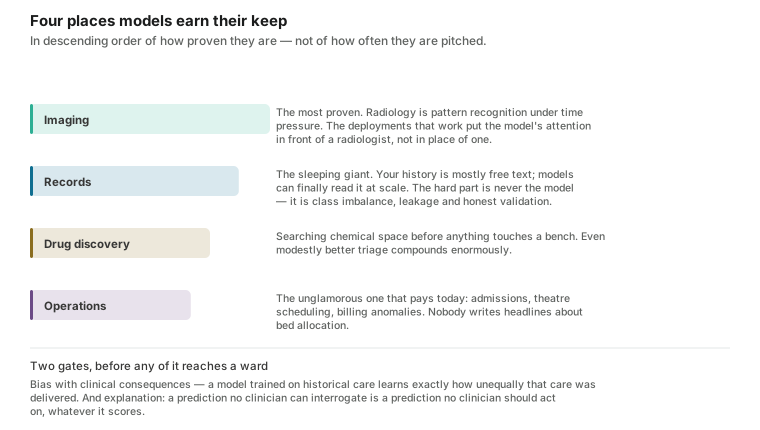
The order of that list is roughly the reverse of how often each one gets pitched.
Now the failure modes, because in medicine they aren’t footnotes. They’re the story.
The first is bias with clinical consequences. Models learn from historical care, and historical care was not delivered equally. A famous US algorithm used spending as a proxy for need and systematically under-referred Black patients: less money had been spent on them, so the model concluded less care was needed. No one intended that. It’s what training on the past means, and only deliberate auditing catches it.
The second is the black-box problem, and medicine is where I’m least tolerant of it. A prediction no clinician can interrogate is a prediction no clinician should act on, whatever its accuracy score. If the model can’t show its reasons, it isn’t ready for the ward. In this field, explanation isn’t a feature request. It’s the price of admission.
The near future is more of the real stuff: multimodal models reading images, records and genomics together, and earlier detection for diseases where every month matters. The realistic frame stays the same, though. The scarce resource in medicine is trained human attention, and the technology’s proper job is aiming that attention where it’s needed most. Tools, not oracles — and the systems built with that humility are, so far, the only ones that have actually made patients better off.