

The internet solved a long list of hard old problems and sent us the bill in a currency we didn’t know we’d be paying.
The problems it solved were economic, and it’s easy to forget how real they were. Information used to be scarce and expensive; now it’s free and instant. Communication was slow; now distance barely exists. Whole industries reorganised around that abundance, and most of us are richer for it in every way that’s easy to measure.
The bill arrives in the ways that are hard to measure. A feed is a comparison engine, and it never runs out of people doing better than you — richer, fitter, happier, at least in the thirty seconds they chose to post. Self-worth starts keeping score in likes. And anonymity, which genuinely protects some people, also staffs a permanent volunteer army of cruelty. None of this was the plan. It’s just what happens when three billion people move their social lives into an attention market.
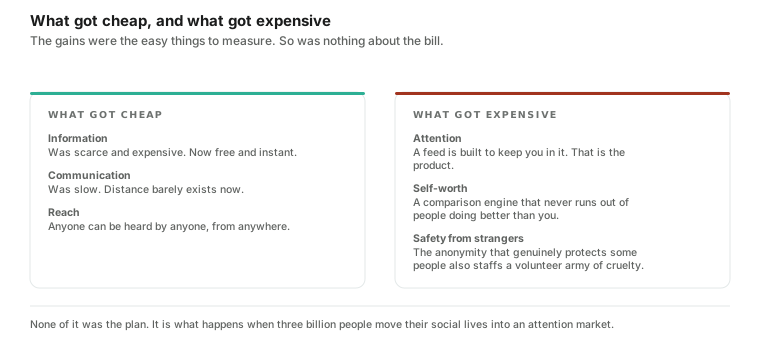
Everything in the left column is easy to count, which is why it dominated every argument about whether this was going well. Nothing in the right column has a unit.
So what do you actually do about it? I don’t think the answer is dramatic, and I’m suspicious of anyone selling one. A few things seem robustly true, though.
Log off sometimes, on purpose. Not as a digital detox with a hashtag — just the ordinary practice of being somewhere the scoreboard can’t see you. A walk, a paper book, a conversation that nobody’s performing.
Teach the mechanics, especially to kids. A person who understands that the feed is optimised to keep them scrolling has a fighting chance against it; a person who thinks it’s a neutral window onto the world doesn’t. That’s a literacy, and like any literacy it has to be taught on purpose.
And take the harassment problem seriously as a design and policy failure, not a character one. Telling targets to toughen up has been tried; it doesn’t scale. Platforms that want safe spaces can build for them, and regulation has a legitimate role where they won’t.
The tool isn’t going away, and I wouldn’t want it to — my whole field exists because of it. But a tool this powerful deserves to be handled deliberately. We shape these systems, and then they shape us back. The only real mistake is pretending the second half of that sentence isn’t happening.