

Airlines are a strange business: colossal fixed costs, brutal margins, and an operation where a single cascading delay can burn a day’s profit. That combination makes them one of the places where machine learning stops being a brochure word and starts paying for itself in specific, countable ways.
Where does the money actually come from? Mostly four places.
Fuel and routing. Flight planning is an optimisation problem with weather, winds, traffic and cost all moving at once, and models trained on past flights find efficiencies that hand-built plans miss. A fraction of a percent of fuel across a fleet is serious money.
Maintenance is my favourite, because it’s the same problem we solve for mining equipment: predict the failure before it grounds the machine. A component that fails on schedule is a line item. One that fails at the gate is cancellations radiating through a network all day. Models that estimate remaining life from sensor data move failures from the second category into the first.
Fraud, quietly, is huge. Stolen cards and forged documents flow through booking systems at volume, and learned models catch patterns in that stream no rule-writer anticipated.
And the customer-facing layer everyone actually meets: chatbots handling bookings and check-in questions, and recommendation systems deciding which fare or route to offer you. Useful, if oversold — which brings me to the honest part.
The airline chatbot is also where the technology’s limits are on public display. These systems handle the routine beautifully and fail exactly when you need them most: the cancelled connection, the weird itinerary, the situation with no template. Everyone who has shouted “agent!” at a phone tree understands the boundary between AI at its best and AI at its worst. It isn’t shy about showing you.
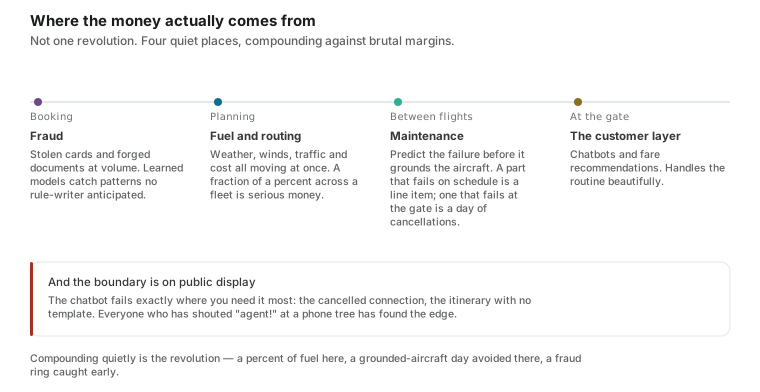
Three of those four are invisible to passengers, and they are where the money is. The one everybody meets is the one with the worst failure mode.
Two other caveats belong in any honest account. Displacement is real: automation here means fewer humans doing the routine work, and “retraining” has to be a programme, not a press release. And bias can ride along in anything trained on historical customer data: a pricing or screening model that learned from the past will happily reproduce it. Aviation’s own safety culture is actually the model here, with its nearly fanatical insistence on knowing why systems do what they do before trusting them. The industry that invented the checklist and the black box shouldn’t accept unexplainable models for consequential decisions, and increasingly it doesn’t.
So: revolutionising? I’d say something less cinematic and more valuable. AI in aviation is compounding: a percent here in fuel, a grounded-aircraft day avoided there, a fraud ring caught early. In an industry with these margins, compounding quietly is the revolution.